





By blending nostalgia and modern technology, Magnus Bredin, an engineer based in Mölndal, Sweden, has an ambitious vision to reimagine a classic. His passion project, ELRV, breathes new life into the iconic Swedish scooter “Larven”, transforming a beloved vintage snowmobile into a fully electrified and modern vehicle.
News
19/08/2025
by Emil Bergqvist
Electrifying the classic snowmobile ‘Larven’ with the help of Kvaser Wireless CAN
History and cultural status of Larven
The original Larven (Swedish for “The Caterpillar”) is a favored snowmobile among enthusiasts, with a unique place in Swedish history. Created by Lennart Nilsson in 1965 and designed for travelling across snowy terrain, it was both lightweight and compact enough to fit in a ski track and in the trunk of a car.
Larven consisted of a long caterpillar track, with the engine placed right behind the driver. A distinctive feature was a steering system that required the driver to wear skis, using body weight and leaning movements to steer the vehicle.
This unique approach to control contributed to its remarkable maneuverability, and in the 1970’s, it was used both in forestry and by rescue services. About 4500 units were built and sold, and it still has a cult status among enthusiasts today.
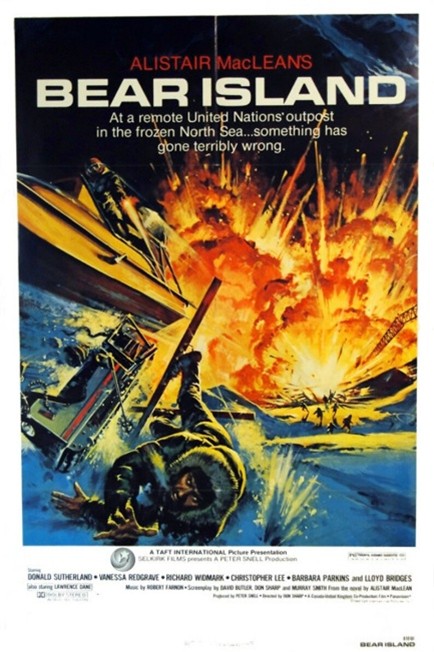
Larven even made a cameo appearance in the 1979 adventure film Bear Island, starring Donald Sutherland, Vanessa Redgrave and Christopher Lee. Two Larven snowmobiles were used during a dramatic chase scene, showcasing Larven’s unique capabilities on the big screen.
The electrification of Larven
Magnus Bredin’s professional background rooted in electrification sparked an idea, combining his expertise with the classic Larven, bringing it back into the modern era:
“Larven was manufactured in Östersund, where I’m from. So, it’s a bit of an iconic, classic thing that has always been in the back of my mind”.
“It started several years ago as a small hobby idea. I’ve worked with electrification in my entire career, so I already had that experience. Then I stumbled upon Larven, where a lot aligns with electrification; it’s lightweight and a simple concept – so it was an idea that took off”.
Magnus Bredin recognized that the Larven was ideal for electric conversion. The battery fits where the fuel tank and storage space were, whilst the electric motor replaced the variator behind the driver, optimizing balance. Magnus Bredin primarily focuses on the drivetrain, battery and electrical components and collaborates with others on mechanical development.
Collaboration with Kvaser
Magnus Bredin’s connection with Kvaser came about through a coincidence:
“I met up with an old army friend, Mårten Ekman, at a reunion event. I told him a bit about this project and the challenges we faced”.
“A challenge with this type of product is that it requires quite a lot to operate it – it’s sub-zero temperatures, you’re wearing winter clothes. Being able to tune and do things is a challenge when you have to carry a PC.”
Mårten Ekman, then working at Kvaser, saw the potential of a new wireless CAN bridge product that he was working on to help Magnus Bredin – the Kvaser Air Bridge. The ELRV project proved to be an ideal pilot for us at Kvaser as it allowed us to test the Air Bridge in demanding winter conditions. Magnus Bredin received two pre-production Air Bridge units and began rigorous testing, both on a test bench and within the ELRV snowmobile itself.
The value of wireless connectivity
By using the Kvaser Air Bridge, Magnus Bredin could now have the PC in the garage while he was doing tests on the snowmobile outdoors:
“Now you can stand in a garage with the PC; if you had run the CAN bus line directly on the snowmobile, you would have needed to bring the PC with you. It has facilitated efficiency when we’re testing, tuning, and measuring, etc. So, I would say that’s the big advantage”.
The wireless capability of the Kvaser Air Bridge was especially helpful during the early stages of development when it required identification and resolution of numerous bugs:
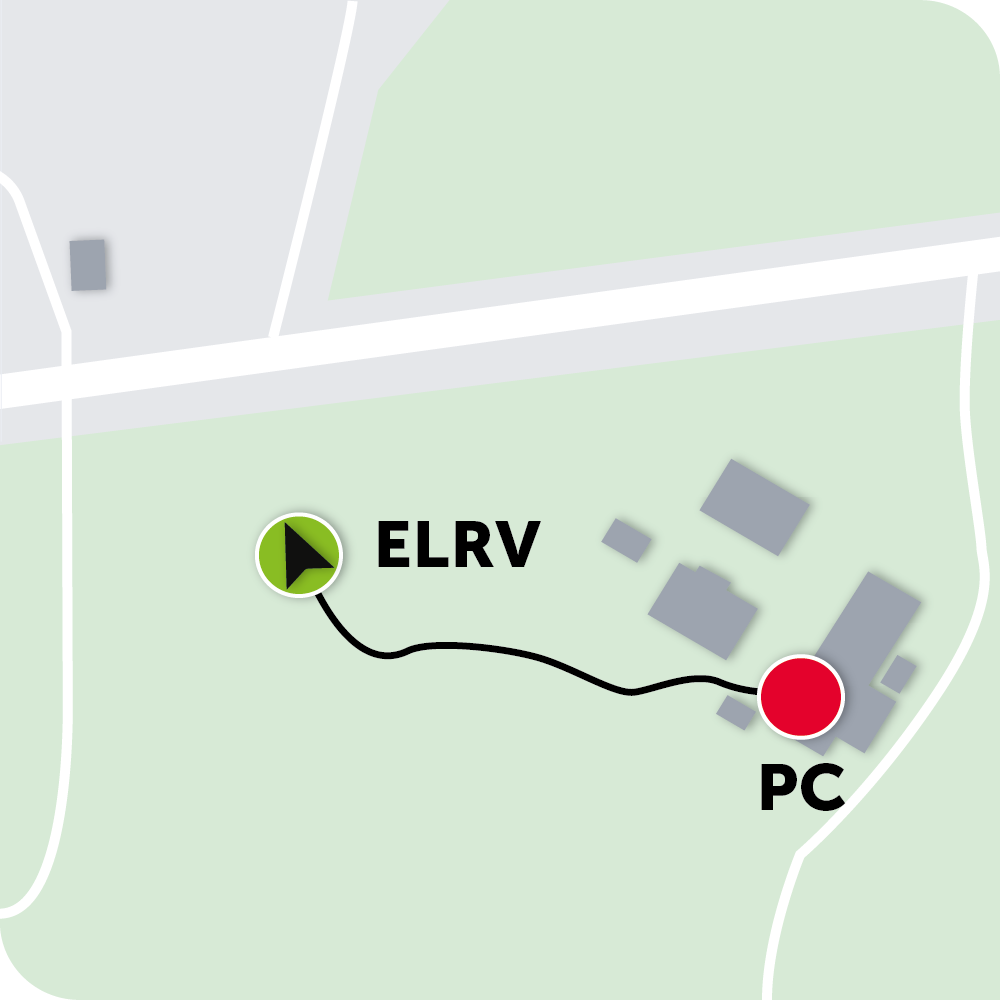
“When we were out, I measured the range up to 400-500 meters, and it’s very practical for those initial tests when you have a lot to resolve and fix. So, it’s been a great advantage to be able to do it that simple way”.
This was particularly beneficial given the time constraints for snowmobile testing, which heavily depends on the presence of snow:
“The last prototype we built here, we missed the snow because it disappeared so early, so we went to the Ski Dome here in Gothenburg. Then you have one evening or one day to test – so that’s where it has been a great advantage”.
Collecting data for the ELRV
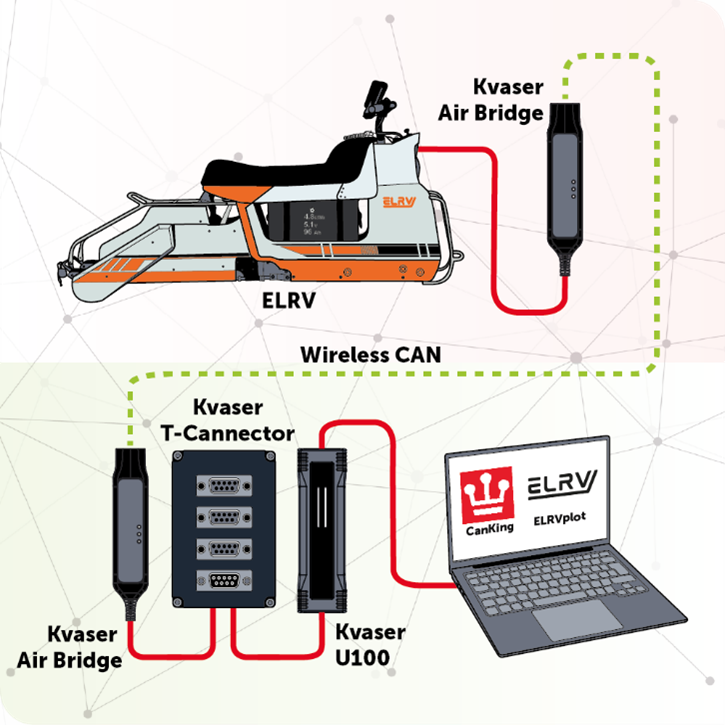
The typical setup involves connecting one Air Bridge unit to the ELRV’s CAN bus line, where it draws power directly from the system of the scooter. The second Air Bridge unit is connected to a computer via a Kvaser U100 interface and a Kvaser T-Cannector bus hub, enabling seamless wireless communication.
For data analysis and system tuning, Magnus Bredin uses the Kvaser Air Bridge to acquire raw data into Kvaser’s CanKing software. Data such as motor currents and temperatures, is then extracted and translated by a Python application he created – ELRVplot:
“We’ve used the raw data coming in via CanKing, and then we’ve had a Python program that converted it. There are essentially two things we’ve done: one is parameter setting, where you set parameters and so on for tuning, and the other is measurements to look at curves and such.”.
This tailored approach provided Magnus Bredin with precise data and in-depth analysis for fine-tuning the performance and advancing the ELRV’s capabilities.
Next step of the ELRV
As the ELRV project matures, Magnus Bredin is shifting focus beyond prototyping to extended field tests. With a working product in hand, he sees the value of a portable data logger like the Kvaser Memorator for tracking performance during longer runs.
A Kvaser Memorator allows for continuous data collection over extended periods in remote areas, where wireless connectivity and cellular coverage are unreliable or nonexistent.
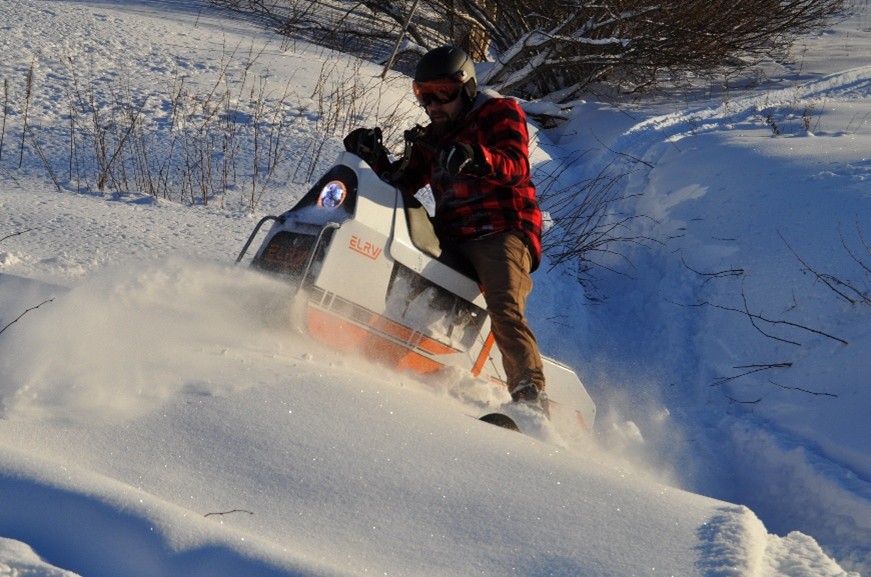
It can collect the same valuable data, but the data is saved directly on one device for later in-depth analysis. This enables a more thorough understanding of the ELRV’s performance in varied long-duration operational scenarios.
Magnus Bredin’s ELRV project showcases how a hobbyist’s passion can modernize classic technology. With help from the Kvaser Air Bridge, data collection became more practical in tough conditions.
As ELRV continues its journey forward, with insights gained from testing facilitated by wireless CAN connectivity, ELRV will pave the way for a new generation of electric snow scooters, carrying forward the spirit of the iconic Larven.
You can follow Magnus Bredin’s passion project with the ELRV here.
 linkedin
 twitter
 youtube
 youku
youku weixin
 1...2...3...