





A sponsorship from Kvaser and CAN Automation helped pave the way for NU Racing to achieve their best-ever result at the Formula Society of Automotive Engineering Australasia (FSAE-A) event in Winton, Victoria, in 2022 – 4th place overall.
News
21/05/2023
by Kvaser
Kvaser and CAN Automation help NU Racing achieve best-ever result at FSAE-A
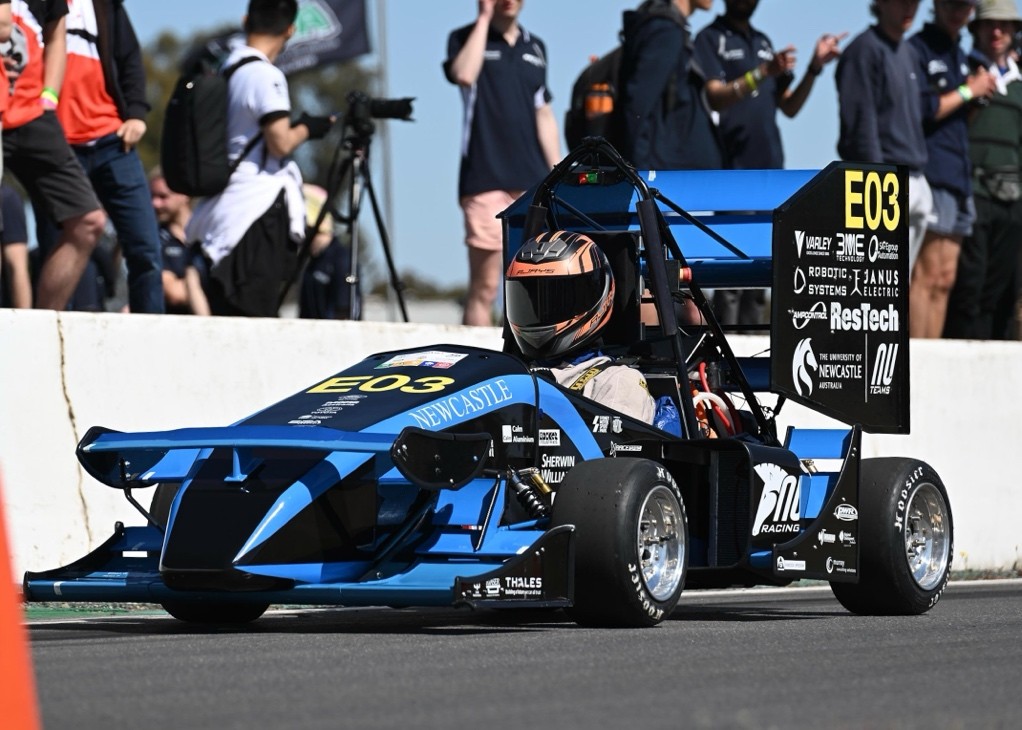
Based in New South Wales, Australia, NU Racing is the University of Newcastle’s FSAE-A team. They recently adopted an electric powertrain for their EV.Three, which has become their most successful vehicle. EV.Three represents the culmination of three-years of work, featuring MIL-Spec wiring looms, bespoke PCBs, a full aerodynamics package, and a twin inboard powertrain.
The provision of two Kvaser Leaf Light HS v2 CAN interfaces was instrumental in the success of NU Racing in 2022. Manufacturing an Electric Vehicle (EV) presents a number of additional challenges compared to the traditional internal combustion cars, not least the requirement of off-the-shelf and bespoke CAN-enabled ECUs throughout the car.
Dr Alexander Gregg, Director of Student Teams, explains why they chose Kvaser’s CAN interface.
“For our team, ease-of-use/low barrier-to-entry was paramount. We don’t utilise every facet of the CAN standard – we almost exclusively use 1 Mb/s classical CAN with one signal per message – but have a lot of new CAN users each year.
The Kvaser Leaf Light HS v2 – particularly with the MATLAB vehicle network toolbox – has been a game-changer for us. An untrained user can simply load in the DBC and read the bus traffic.”
The team uses CAN extensively throughout their EV. Their electrical systems utilise a distributed topology, with many CAN nodes throughout the car, each providing small blocks of functionality. This naturally makes black-boxing/integration/diagnosis easier, but relies on robust communication between these nodes.
Previously, when integrating and diagnosing their CAN nodes, the team would unit-test, integrate, and troubleshoot CAN ECUs on their car with an in-house, custom, microcontroller-based solution. While functional, this ‘CAN Sniffer Board’ required an in-depth knowledge of CAN to operate which proved to be an additional barrier-to-entry for new users and younger students… and it was time-consuming to program.
Electrical Systems lead, Matt Whitworth, who has been responsible for much of the CAN architecture on their EV, said:
“Having already used the Kvaser DBC Editor for a number of years, we are thrilled to be working with Kvaser and CAN Automation. It made perfect sense to adopt the Kvaser Leaf Light HS v2 into our workflow, both for design of new systems and for use by our junior team members, as the barrier-to-entry working with this unit is very low. We were up and running with the MATLAB toolbox in minutes!”
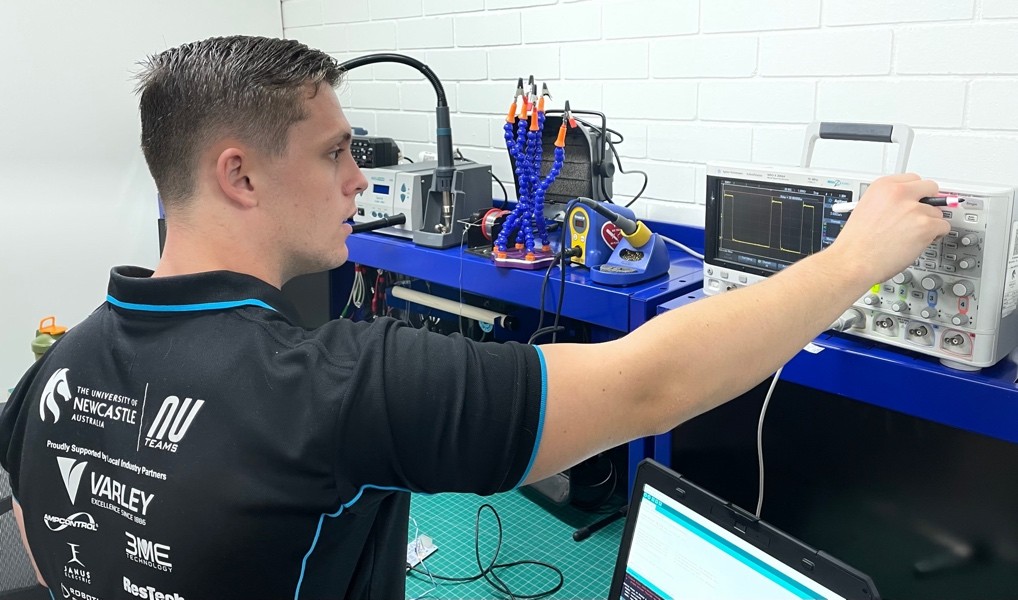
Kvaser Leaf Light HS v2 interface for unit-testing, integration, and troubleshooting of their CAN ECUs. In addition to being used by their EV team, Autonomous Systems Lead Christopher Neal recently integrated an off-the-shelf Bosch iBooster for use on their Autonomous Vehicle (AV) testbed using the Kvaser Leaf Light HS v2 units and MATLAB CAN Explorer app.
What’s the plan for 2023? Dr Alexander Gregg explains.
“After our best-ever result in 2022, NU Racing is focussed on steady improvement in the reliability and serviceability of our vehicle for 2023. The team is currently on a mission to radically reduce the weight, part count, and complexity of their car. A 50kg weight decrease is planned.”
Well done NU Racing and The University of Newcastle on your 4th place last year – we wish you continued success for 2023 and beyond!
Which Kvaser products are NU Racing using?
Kvaser Leaf Light HS v2 – this represents one of the easiest and lowest-cost methods of connecting a computer to a CAN bus network. With its USB 2.0 compliant connector and 9-pin D-SUB connector, the Leaf Light HS v2’s sleek, ergonomically designed housing is both robust enough for everyday use and small and flexible enough to be used in space-constrained applications. Now with galvanic isolation as standard.
Who is involved?
More information
Formula SAE-A (FSAE-A) challenges students to conceive, design, fabricate, and compete with small formula-style racing cars. Teams spend 8-12 months designing, building, and preparing their vehicles for a competition. These cars are judged in a series of static and dynamic events, including technical inspection, cost, presentation, engineering design, solo performance trials and high performance endurance.
https://www.saea.com.au/formula-sae-a
With thanks to Dr Alexander Gregg, Director of Student Teams at the School of Engineering, University of Newcastle, Australia.
 linkedin
 twitter
 youtube
 youku
youku weixin
 1...2...3...