





Arbitration
CAN XL was designed to work smoothly with existing CAN protocols. Like CAN FD and CAN CC, a CAN XL frame begins the start of frame with a dominant edge followed by the 11-bit CAN identifier to determine priority among the frames on the bus. The RTR bit will be dominant as neither CAN FD nor CAN XL support this feature. Next to follow is the IDE bit, which always is dominant as CAN-XL only supports 11-bit CAN-ID/priority. Up to this point, an XL frame is largely the same as a CAN or CAN FD frame.
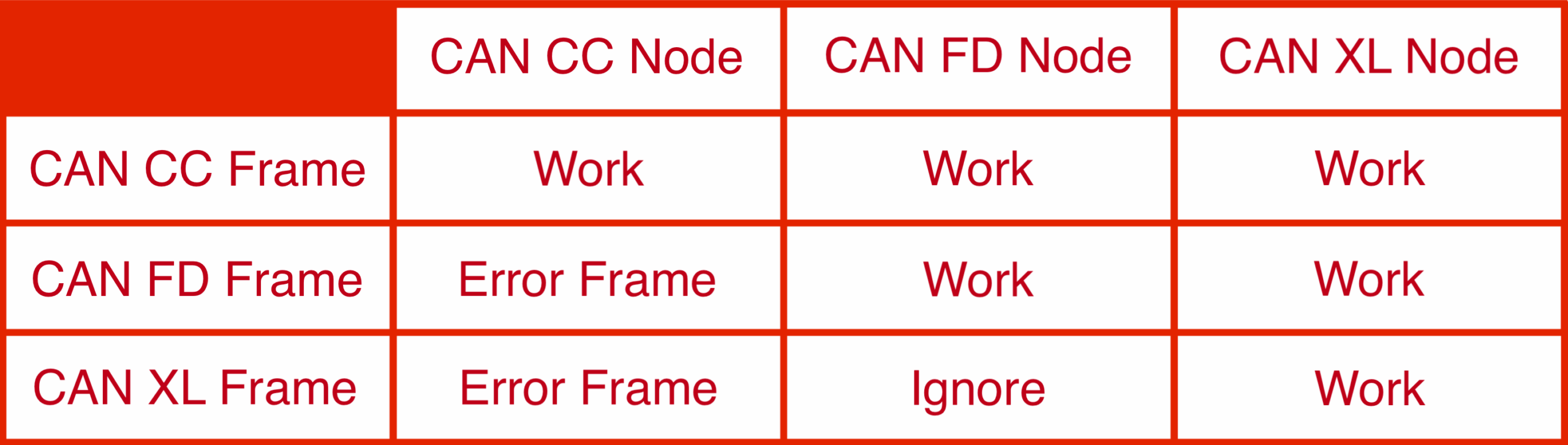
When the next bit, the FDF, is set as recessive rather than dominant, this indicates this is an FD frame. A CAN CC node when seeing this will not know what to do and in turn send an error frame while an FD or XL node will recognize this as an FD frame. The following bit, XLF, was reserved in the CAN FD standard for possible future versions. Should the bit be recessive, indicating an XL frame, CAN FD nodes will ignore all following bits including push-pull signaling and disable error-handling until the end of frame. Like the CAN FD protocol, CAN XL is also designed with future protocols in mind. The bit after XLF, resXL functions like FDF and when set as recessive, CAN XL nodes will ignore all bits up to the end of frame. For a breakdown of how CAN nodes react to these frame type settings, please review the table on this page.
 1...2...3...