





An OEM needed an affordable, flexible HIL setup. Combining RemotiveLabs’ cloud-native simulation platform with Kvaser’s PCIe interfaces, Linux drivers, and a custom Python app, they cut costs, reduced risk, and enabled desk-level level testing, with no full rig required. The result? Agile development, reusable hardware, and control over the test environment, all in step with the fast-growing HIL market.
News
23/10/2025
by Kvaser
From complexity to control: Bridging SIL and HIL with RemotiveLabs, ECM and Kvaser
Challenge
Hardware-in-the-Loop (HIL) testing is essential for validating modern automotive systems, but it’s often seen as complex, costly, and resource intensive.
A typical HIL setup needs to observe the environment via CAN, LIN, voltage sensors, and other network inputs, then feed that data to an ECU, which in turn drives outputs such as lamps, motors, or actuators. Inputs and outputs span multiple protocols – CAN, LIN, FlexRay, UART, J1708/1587 and Ethernet – each adding layers of configuration and integration.
For many OEMs, especially smaller teams, the challenge is twofold: high entry cost, as commercial HIL systems require significant investment in hardware, software, and training, and limited flexibility, as booking time on shared rigs slows iteration, and proprietary ecosystems can lock teams into specific tools.
One customer summed it up: “It’s too complicated and too expensive for what we need.”
Solution
The OEM built 30 automated test racks, each requiring 3 to 4 cards, using:
- PCIe 8-channel boards and Hybrid CAN/LIN USB interfaces
- CANlib and SocketCAN support, enabling a Linux-based Python test application to be developed.
- LIN responder simulation for protocol coverage
- Kvaser Arcus Media Converter (coming soon)
The hardware is reusable across projects, enabling desk-level testing without full rigs.
- RemotiveTopology enables consistent development across SIL and HIL
- Supports virtual ECUs, mock nodes, and real hardware
- Uses standard Linux tools and integrates with CI/CD pipelines
- Enables ad hoc setups that scale with project needs
- Supplied test racks and integration help to the OEM
- Custom built a Linux computer that met the OEM’s specifications and connected all Kvaser hardware.
Together, these technologies allow teams to test ECUs and vehicle functions in hybrid environments, mixing virtual and physical components seamlessly.
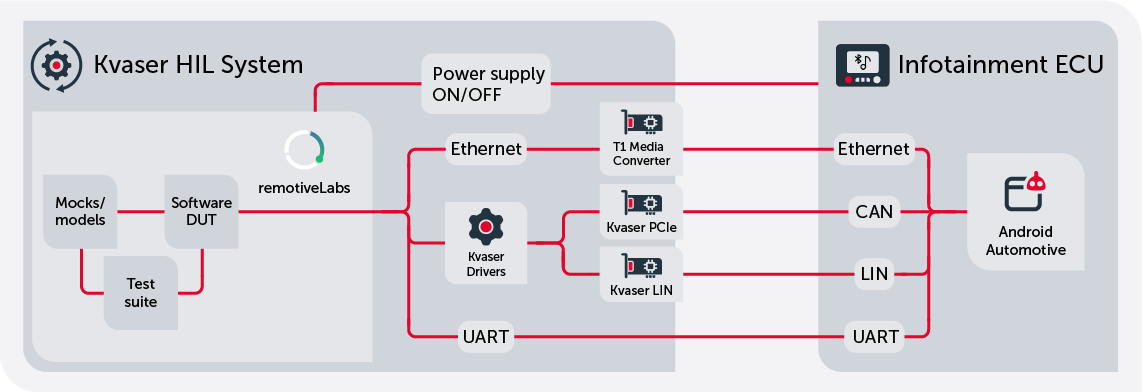
This solution combines readily available PCIe and USB hardware with open, developer friendly software.
Key attributes included:
- Fast startup: Openly available Linux meant that our customer’s engineers could get running without proprietary roadblocks.
- Hardware reusability: Boards could be redeployed in other projects, reducing risk.
- Desk level validation: Engineers could test components without booking a full HIL rig; ideal for ‘proof of concept’ work.
- Platform flexibility: Systems could run in the same environment, so swapping between platforms causes minimal friction.
- Scalable approach: Small teams can start with a narrow scope and expand as needed.
Conclusion and looking to the future
The HIL market is increasingly being driven by software savvy engineers comfortable with scripting and command line tools. Kvaser’s open, modular approach taps into this shift. Our solutions give customers control over their information and the freedom to build industrial computers to their own spec.
Whether you’re building full-scale rigs or testing on a laptop, Kvaser and RemotiveLabs offer the tools to move faster, test smarter, and innovate with confidence.
 linkedin
 twitter
 youtube
 youku
youku weixin
 1...2...3...