




As vehicle systems grow more complex, engineering teams are being asked to do more with less time, less physical access, and increasingly distributed teams. Whether validating algorithms, collecting CAN data, or supporting remote colleagues, one challenge keeps resurfacing: engineers are still physically tied to their test hardware.
News
28/06/2026
by Kvaser
Breaking the tether: A remote CAN data workflow with Kvaser Edge and MATLAB
At MathWorks Automotive Conference 2026 North America, Kvaser and MathWorks set out to show that it doesn’t have to be this way.
Challenge: Physical tethers and rigid data pipelines
For many teams, the pain points are familiar:
- Engineers must be on site to collect data
- Data needs to be manually transferred before analysis
- Cloud workflows can be inflexible or vendor-locked
- Remote experts can’t easily access live data
- Iteration is slowed by disconnected collection and analysis
Solution: A fully remote, flexible CAN pipeline
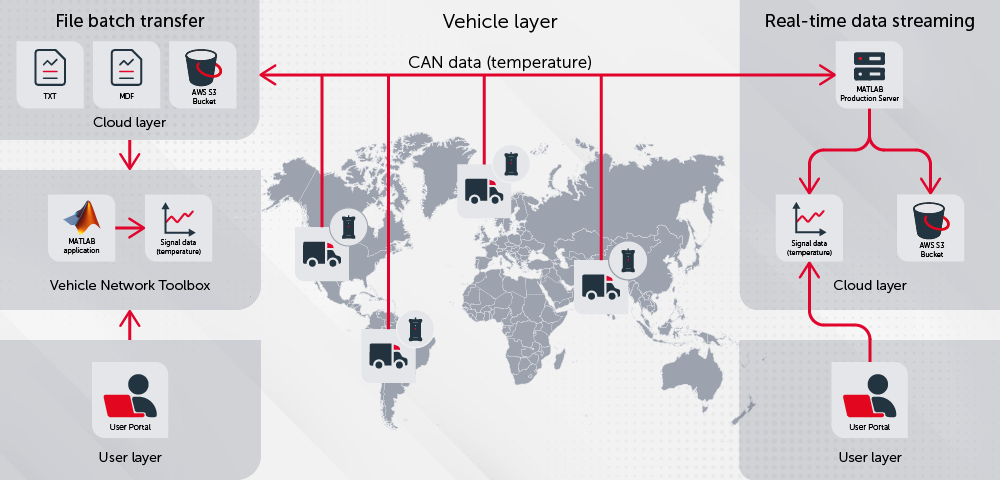
Kvaser FAE Adam Raymer and MathWorks software engineer Govind Suresh built a demo using a Kvaser Edge to stream CAN data simultaneously to three destinations:
- AWS S3 as a .txt log
- AWS S3 as an MF4 file
- MATLAB in the cloud via MATLAB Production Server (MPS)
CAN data was simulated in Kvaser CanKing 7, modelling a rising temperature signal at 500 kb/s (~1 message/sec). The data was sent in batches of 500 records, using a single collection pipeline with flexible output paths.
The live MATLAB stream enabled real-time plots and analytics. Data arrived as raw frames, then VNT functions such as canMessageTimetable, canSignalTimetable, and canDatabase decoded it via a CAN DBC into structured timetables. The temperature signal was visualised instantly and saved to MDF using mdfWrite.
Meanwhile, S3 logs supported replay, deeper analysis, and automation.
Because the Kvaser Edge device was networked and ran a web server (Apache2), the entire setup could be monitored and controlled remotely via a browser-based interface. During the demo, Govind was able to connect to the system and refresh data directly from his phone, highlighting the flexibility of the setup.
Key attributes included:
Untethered testing: Access and control the system remotely via any browser, which is ideal for long-running tests, shared vehicles, and distributed teams.
No cloud lock-in: The workflow is script-driven, so data can be sent to AWS, Azure, Google Cloud, or directly to MATLAB, depending on user needs.
Scalable remote analytics with MPS: MATLAB Production Server enables the Edge hardware to call deployed MATLAB functions in the cloud, removing the need for a local MATLAB installation. With multi-core processing, MPS can scale to handle higher data rates and larger datasets, processing data streams in parallel when needed.
This approach scales well across larger fleets and a wide variety of signals. The decoding workflow remains consistent regardless of data size, and functions like canSignalTimetable allow users to extract specific signals into dedicated timetables. Writing live CAN data to MDF files provides a practical solution for long-term storage, with the ability to reload and analyse data later in MATLAB.
Faster iteration loops: With live data streaming, immediate visualisation, and remote access, engineers can validate algorithms and adjust parameters in real time, without waiting for manual data transfers.
A future-proof architecture: By using open file formats and standard cloud services, the workflow integrates naturally into modern DevOps pipelines and automated testing environments. It is particularly well suited to use cases such as fleet testing, with potential expansion into areas like OBD2 diagnostics and full-vehicle data acquisition.
Conclusion
According to Raymer, the audience at MathWorks’s annual conference appreciated the system’s flexibility: “Many were surprised by the ability to choose any cloud destination and control everything through a simple, browser-based interface, even a phone.”
While this exact MPS workflow is not yet published, similar CAN data processing examples exist in MathWorks documentation. Meanwhile, Raymer and Suresh are continuing to refine the approach and explore future opportunities.
Find out more
To explore the technologies behind this demo, visit:
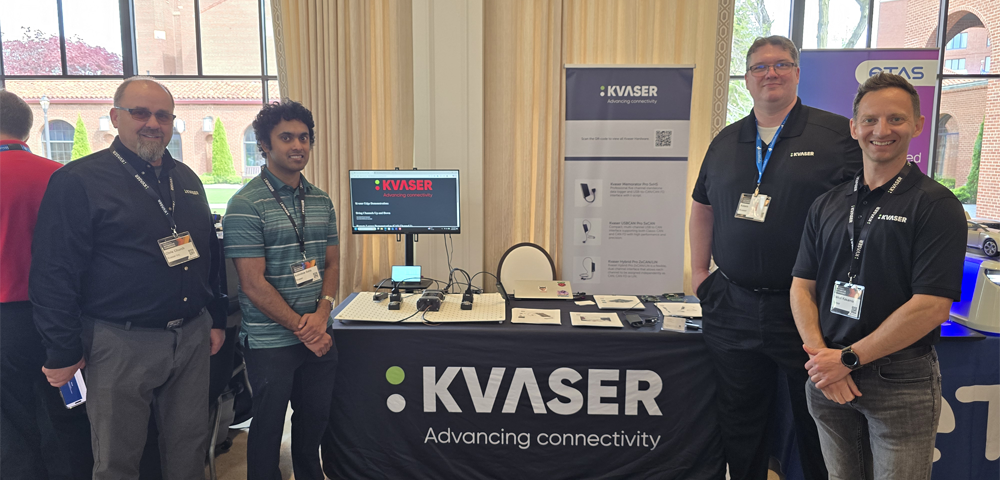
Kvaser’s Dan Kasamis, Adam Raymer, and Chris Church with MathWorks software engineer Govind Suresh showcasing their joint demo at the MathWorks Automotive Conference 2026 North America.
 linkedin
 twitter
 youtube
 youku
youku weixin
 1...2...3...