





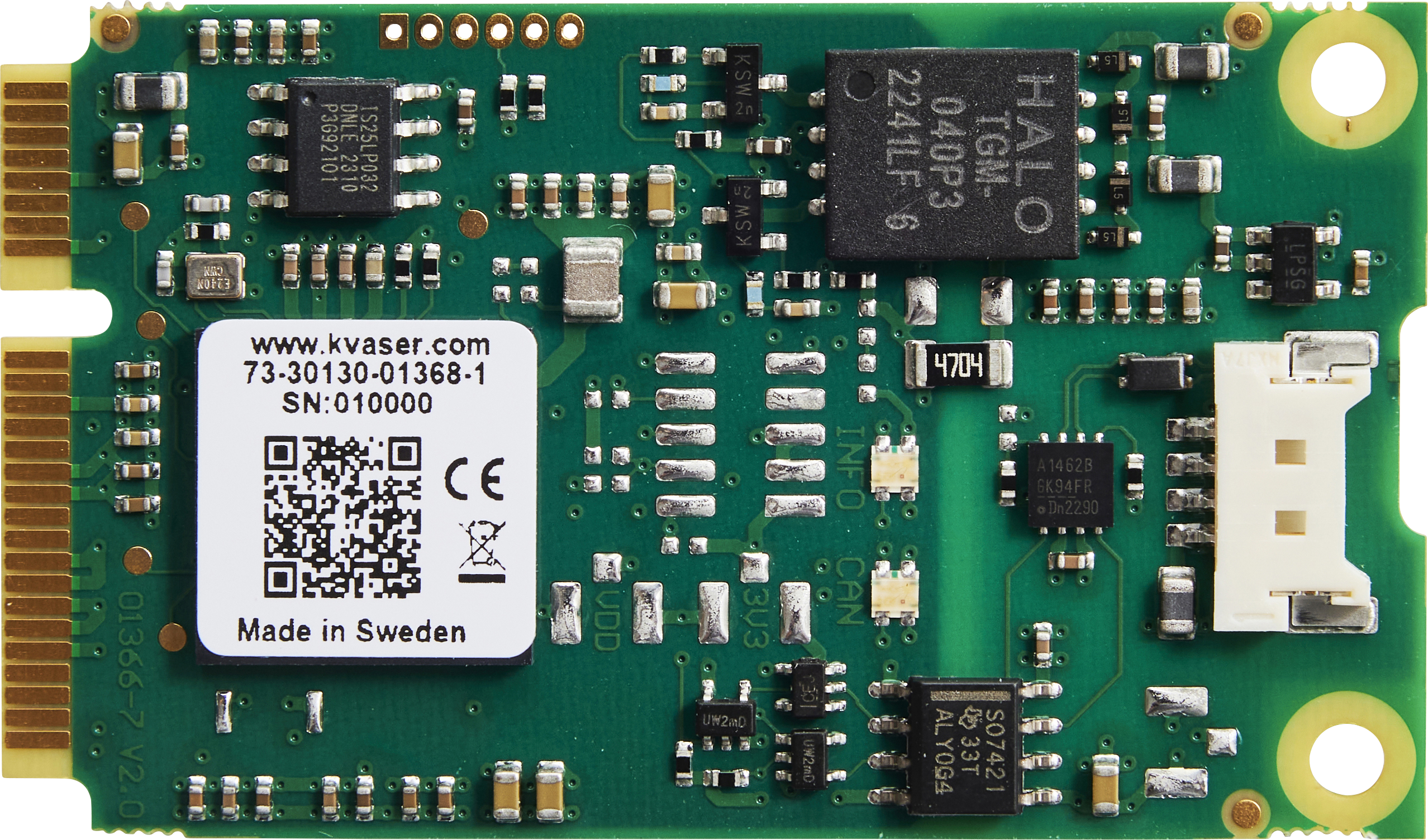
Kvaser offers four compact CAN interface cards in the Mini PCI Express (Mini PCIe) form factor for embedded computer applications, as of March 2025. The main difference between them is how they communicate with the CPU on the motherboard:
Developer Blog
23/04/2025
by Kvaser
Kvaser Mini PCIe Interface Cards: Key Differences & Selection Guide
| Name | EAN | Lane used |
|---|---|---|
| 73-30130-01368-1 | USB | |
| 73-30130-00743-7 | USB | |
| 73-30130-01420-6 | PCIe | |
| 73-30130-01417-6 | PCIe |
Understanding the Difference
These cards follow the Mini PCI Express standard, which allows them to connect via either
PCI Express x1 or USB 2.0. However, motherboard manufacturers aren’t required to support both connections—some only provide PCI Express lanes, while others only support USB.
Why don’t they connect both? The design choice is primarily driven by resource constraints, the PCI Express lanes are a limited resource on the CPU and chipset. Some Mini PCIe cards do not require the speed of a ultra-fast PCI Express lane, regular USB 2.0 connectivity would suffice.
Choosing the right card
To determine which Kvaser Mini PCIe card will work for your system, check your motherboard’s specifications. Look for details on Mini PCIe expansion slots in the datasheet:
- If it mentions ‘PCIe x1, USB 2.0’, then you can use PCI Express- and USB-based cards.
- If it only lists ‘Mini PCIe x1 (Gen 3)’, it likely supports PCIe but doesn’t specify USB.
If the datasheet isn’t clear, ask the supplier whether the Mini PCIe slots support PCIe, USB, or both. In some cases, testing the card directly may be the only way to confirm compatibility.
Product comparison
| EAN | 01368-1 | 00743-7 | 01420-6 | 01417-6 |
|---|---|---|---|---|
| Name | Kvaser Mini PCIe 1xCAN | Kvaser Mini PCI Express 2xHS | Kvaser Mini PCI Express 1xCAN v3 | Kvaser Mini PCI Express 2xCAN v3 |
| Mode | USB | USB | PCIe | PCIe |
| CAN FD | YES | NO | YES | YES |
| # CAN channels | 1 | 2 | 1 | 2 |
| Galvanic isolation | YES | YES | YES | YES |
| Operation system | WIN+LINUX | WIN+LINUX | WIN+LINUX | WIN+LINUX |
| Silent mode | YES | YES | YES | YES |
As you can see in the table above, there are no major differences in the features, except that 00743-7 cannot handle CAN FD frames.
Performance differences
>Q: Does the communication method affect performance?
Yes – PCI Express and USB communicate differently, impacting performance:
- PCI Express communication is extremely fast, offering low latency between the CPU and the CAN controller.
- USB communication, while fast, is slower than PCI Express due to its more complex implementation on the motherboard.
>Q: Does this matter in standard applications?
For typical CAN applications, no—there’s usually no noticeable performance difference. However, applications that require heavy ECU flashing may benefit from a PCI Express interface for faster data transfer.
Driver & SDK Differences
All Kvaser CAN and LIN interfaces share the same drivers and SDK, making software compatibility straightforward. In most cases, switching between Kvaser interfaces won’t require changes to your software as long as the installed version supports the interface.
However, there are exceptions:
- Linux Kernel & SocketCAN: The Linux kernel controls the built-in version of SocketCAN, meaning some products may require a minimum kernel version to function correctly.
- Driver Updates: Using an outdated driver might mean newer Kvaser products aren’t recognized, so we recommend always using the latest drivers and SDK for full compatibility.
All Kvaser Drivers & SDK are completely free—no license costs, no hidden fees! And best of all, Kvaser SUPPORT is also free!
KVASER SUPPORT
The Kvaser Support Group is always available for you. Whether you need technical help, have a question about our products, or maybe would like to tell us how great we are, please send a mail to [email protected]
PCI Express Mini Cards are 30 mm × 50.95 mm (width × length) for a Full Mini Card. There is a 52-pin edge connector, consisting of two staggered rows on a 0.8 mm pitch. Each row has eight contacts, a gap equivalent to four contacts, then a further 18 contacts.


 1...2...3...